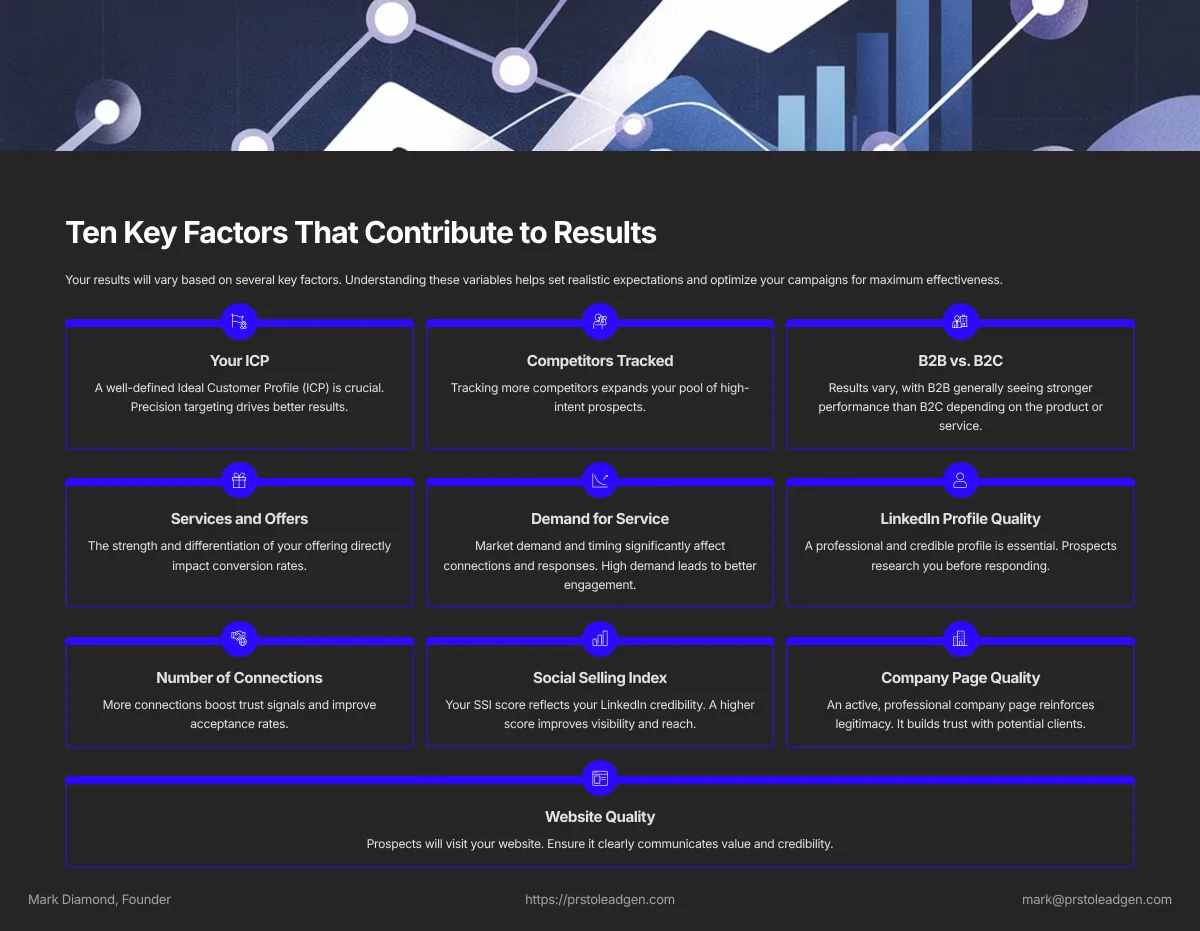
Ten Key Factors That Drive Campaign Results
Ten Key Factors That Drive Campaign Results
Not all campaigns perform the same — and that’s intentional.
Results aren’t random. They’re the outcome of timing, market conditions, and execution quality.
Understanding these ten factors helps set realistic expectations and shows where performance is actually won or lost.
1. Your Ideal Customer Profile (ICP)
Everything starts with a well-defined ICP.
The clearer and more precise your targeting, the higher your connection, reply, and conversion rates.
Vague ICPs produce vague results.
2. Buyer Intent & Competitor Signals
ICP list building alone isn’t enough.
Buyer intent data improves results by identifying prospects actively researching solutions.
Competitor signals take this further by revealing prospects who are already evaluating alternatives.
Timing improves dramatically when outreach aligns with evaluation behavior.
3. B2B vs. B2C Context
LinkedIn performs best in B2B environments, where buying cycles are longer and intent signals are clearer.
Buyer-intent email data is also limited to B2B, making channel strategy especially important for service-based and enterprise-focused offers.
4. Strength of Your Offer
Strong campaigns don’t rely on clever messaging alone.
They rely on clear, credible offers.
If the value isn’t immediately apparent, response rates will suffer — regardless of targeting.
5. Market Demand & Timing
Even great campaigns perform differently depending on market conditions.
When demand is high, engagement rises naturally.
When demand is soft, timing and precision matter even more.
Markets don’t stay static — campaigns shouldn’t either.
6. LinkedIn Profile Quality
Your profile is often the first credibility check.
Precise positioning, professional visuals, and concise messaging increase trust and improve reply rates — primarily when intent already exists.
7. Network Size & Relevance
A larger, relevant network increases familiarity and perceived authority.
Prospects are more likely to accept connections and engage when they see shared context and a credible presence.
8. Social Selling Index (SSI)
Your SSI reflects how actively and effectively you engage on LinkedIn.
Higher scores improve visibility, increase reach, and support stronger campaign performance over time.
9. Company Page Credibility
An active, professional company page reinforces legitimacy.
Even when outreach is one-to-one, prospects often check the company behind the message before responding.
10. Website Clarity & Trust
Your website is the final validation step.
Clear messaging, strong positioning, and credibility signals keep prospects engaged after the first interaction — and often determine whether conversations move forward.
Final Thought
Campaign success isn’t about luck or volume.
It’s built from data, timing, and credibility.
When these ten factors are aligned, results become more predictable, more efficient, and more manageable to scale.

